
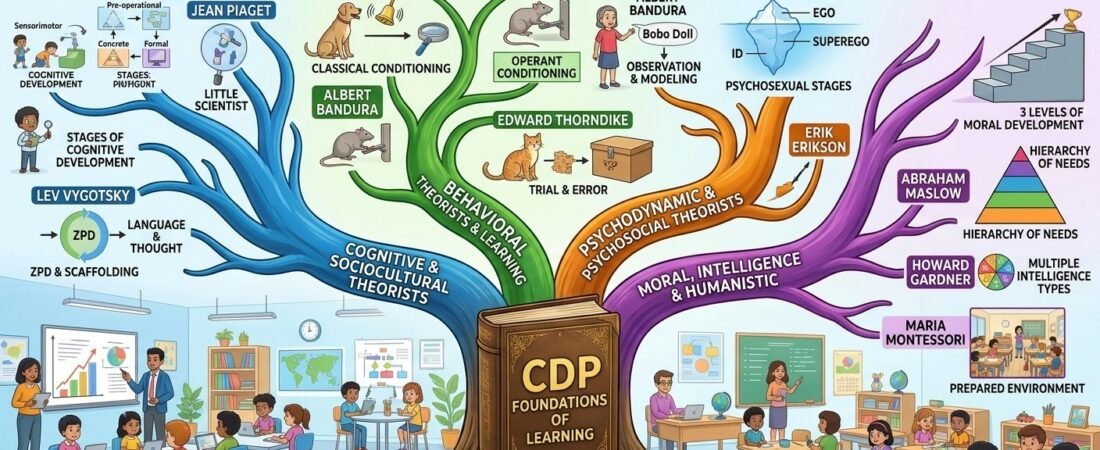
1. Cognitive & Sociocultural Theorists (संज्ञानात्मक और सामाजिक-सांस्कृतिक सिद्धांतकार)
🧠 Jean Piaget (जीन पियाजे) – Cognitive Development Theory (संज्ञानात्मक विकास का सिद्धांत)
Jean Piaget, a Swiss psychologist, is recognized as the Father of Child Psychology. He observed that children are not passive learners but ‘Little Scientists’ who actively construct their understanding of the world through experimentation.
जीन पियाजे को बाल मनोविज्ञान का जनक माना जाता है। उनका मानना था कि बच्चे निष्क्रिय रूप से नहीं सीखते, बल्कि वे ‘नन्हे वैज्ञानिक’ हैं जो अपने अनुभवों और खोजों के माध्यम से दुनिया की समझ का निर्माण खुद सक्रिय रूप से करते हैं।
Core Structural Concepts (मुख्य संवेगात्मक/संज्ञानात्मक अवधारणाएँ):
• Schema (स्कीमा): Mental building blocks of knowledge. It is a cognitive framework or packet of information stored in the mind to understand situations. (ज्ञान की मानसिक संरचना या पैकेट, जिसमें हमारे अनुभव और जानकारी स्टोर होती है।)
• Assimilation (आत्मसातीकरण): Fitting new information directly into existing schemas without modifying them. (पुरानी जानकारी या मौजूदा स्कीमा में बिना बदलाव किए नई जानकारी को जोड़ना।)
• Accommodation (समायोजन): Modifying existing schemas or creating entirely new schemas because new information contradicts old knowledge. (पुरानी जानकारी या स्कीमा में बदलाव, संशोधन या नई स्कीमा बनाना जब नई जानकारी पुरानी स्कीमा में फिट नहीं बैठती।)
• Equilibration (संतुलन): The state of cognitive balance achieved when moving between assimilation and accommodation. (आत्मसातीकरण और समायोजन के बीच संतुलन बनाने की मानसिक प्रक्रिया।)
Four Stages of Cognitive Development (विकास की चार प्रमुख अवस्थाएँ):
• 1. Sensorimotor Stage (संवेदी-पेशीय अवस्था) | 0–2 Years: Learning happens through sensory experiences (taste, touch, sight) and motor actions. Object Permanence develops here—knowing an object exists even if it is out of sight. (बच्चे अपनी इंद्रियों और शारीरिक अंगों के माध्यम से सीखते हैं। इसमें ‘वस्तु स्थायित्व’ का गुण आता है—अर्थात छिपी हुई चीज़ को भी ढूंढ लेना क्योंकि उन्हें पता है कि उसका अस्तित्व है।)
• 2. Pre-operational Stage (पूर्व-संक्रियात्मक अवस्था) | 2–7 Years: Symbolic thought develops, but logical reasoning is absent. Key concepts: Egocentrism (incapacity to see other perspectives), Animism (treating non-living items as alive), and Lack of Conservation (unable to understand quantity stays same despite container shape). (प्रतीकात्मक सोच आती है पर तार्किक सोच नहीं होती। मुख्य विशेषताएँ: अहंकेंद्रित सोच—सिर्फ अपना नजरिया सही मानना; जीववाद—गुड़िया या खिलौनों को सजीव समझना; संरक्षण का अभाव—बर्तन का आकार बदलने पर पानी की मात्रा समान रहती है, यह न समझ पाना।)
• 3. Concrete Operational Stage (मूर्त संक्रियात्मक अवस्था) | 7–11 Years: Logical thinking begins but is strictly limited to concrete (visible, real) objects. Reversibility and Conservation are successfully mastered. Inductive reasoning begins. (तार्किक सोच की शुरुआत होती है, लेकिन केवल मूर्त—सामने दिखने वाली चीजों के लिए। संरक्षण, वर्गीकरण, और पलटावी (Reversibility) का गुण पूरी तरह आ जाता है।)
• 4. Formal Operational Stage (औपचारिक संक्रियात्मक अवस्था) | 11+ Years: Abstract thinking, systematic logic, and hypothetical-deductive reasoning fully develop. Children can formulate theories and think scientifically about ideal scenarios. (अमूर्त चिंतन, व्यवस्थित तर्क और परिकल्पनात्मक चिंतन का पूर्ण विकास होता है। बच्चे बिना देखे भी चीजों के बारे में वैज्ञानिक ढंग से सोचने में सक्षम हो जाते हैं।)
👥 Lev Vygotsky (लेव वायगोत्स्की) – Sociocultural Theory (सामाजिक-सांस्कृतिक सिद्धांत)
Vygotsky, a Soviet psychologist, argued that a child’s cognitive development cannot be understood independently of the social, cultural, and linguistic environment they grow up in. He gave the ‘SCL’ formula (Society, Culture, Language).
वायगोत्स्की का मानना था कि बच्चे का संज्ञानात्मक विकास उस सामाजिक, सांस्कृतिक और भाषाई वातावरण से पूरी तरह प्रभावित होता है जिसमें वह रहता है। उन्होंने माना कि सामाजिक अंतःक्रिया ही सीखने का आधार है।
Core Pillars of Vygotsky’s Theory (वायगोत्स्की के सिद्धांत के मुख्य स्तंभ):
• Zone of Proximal Development – ZPD (समीपस्थ विकास का क्षेत्र): The gap between what a child can achieve completely independently and what they can achieve when given guidance by an expert. (वह दायरा जहां बच्चा बिना किसी मदद के स्वयं कुछ कर सकता है और किसी कुशल व्यक्ति की मदद से जो कर सकता है, उसके बीच का अंतर।)
• Scaffolding (पाड़ / ढांचा / मचान): The temporary structured support provided by an adult or teacher during the learning process, which is gradually withdrawn as the student gains mastery. (सीखने के दौरान दी जाने वाली अस्थायी मदद—जैसे बच्चे को शुरुआत में साइकिल चलाना सिखाते समय पीछे से पकड़ना और बाद में छोड़ देना।)
• More Knowledgeable Other – MKO (अधिक ज्ञानवान अन्य): Any individual who possesses a higher understanding or skill level than the learner regarding a specific task (can be a Teacher, Parent, Peer, or even a Computer). (कोई भी व्यक्ति जिसके पास सीखने वाले से उस विषय में अधिक ज्ञान या क्षमता हो—जैसे शिक्षक, माता-पिता, या सहपाठी।)
• Language and Private Speech (भाषा और निजी वाक): Vygotsky stated that language develops first and acts as the ultimate tool for thought. Private Speech occurs when children talk to themselves aloud to regulate and guide their own behavior. (वायगोत्स्की के अनुसार भाषा पहले आती है और विचार बाद में। ‘निजी भाषण’ या ‘आंतरिक वाक’ वह क्रिया है जहाँ बच्चे अपने स्वयं के कार्यों को निर्देशित करने के लिए खुद से बात करते हैं।)
🌀 Jerome Bruner (जेरोम ब्रूनर) – Discovery Learning & Spiral Curriculum (खोजपूर्ण अधिगम का सिद्धांत)
Bruner proposed that learning is an active process where students discover principles for themselves. He strongly advocated for a Spiral Curriculum, where foundational concepts are revisited repeatedly at increasing levels of depth and complexity.
ब्रूनर का मानना था कि सीखना एक सक्रिय प्रक्रिया है जहाँ बच्चे स्वयं नियमों की खोज करते हैं। उन्होंने सर्पिलाकार पाठ्यक्रम (Spiral Curriculum) का विचार दिया, जिसमें बुनियादी विषयों को बार-बार अधिक जटिलता के साथ पढ़ाया जाता है।
Three Modes of Representation (ज्ञान की अभिव्यक्ति के तीन चरण):
• 1. Enactive Mode (सक्रियता या रचनात्मकता विधि) | 0–1 Year: Representing knowledge entirely through action and physical movement (e.g., learning to ride a cycle or shaking a toy). (ज्ञान को शारीरिक क्रियाओं या मांसपेशियों के संचालन द्वारा अभिव्यक्त करना—जैसे खिलौना हिलाना।)
• 2. Iconic Mode (दृश्य प्रतिमा विधि) | 1–6 Years: Representing knowledge using mental visual images, photos, graphs, and diagrams. (ज्ञान को मानसिक चित्रों, चित्रों, या विजुअल्स को देखकर समझना और दिमाग में रखना।)
• 3. Symbolic Mode (सांकेतिक विधि) | 7+ Years: Representing knowledge through abstract symbols, language, words, and codes. (ज्ञान को अमूर्त प्रतीकों, शब्दों, भाषा और संकेतों के माध्यम से समझना।)
2. Behavioral & Learning Theorists (व्यवहारवादी और अधिगम सिद्धांतकार)
🐕 Ivan Pavlov (इवान पावलोव) – Classical Conditioning (शास्त्रीय अनुबंधन का सिद्धांत)
Pavlov conducted his legendary experiment on a dog, demonstrating that an organism can learn to associate a neutral stimulus (like a bell) with a natural biological stimulus (like food) to produce an involuntary response.
पावलोव ने कुत्ते पर प्रयोग किया और दिखाया कि कैसे एक प्राकृतिक उद्दीपक (भोजन) को एक तटस्थ उद्दीपक (घंटी) के साथ बार-बार जोड़ने पर, कुत्ता केवल घंटी की आवाज सुनकर भी लार टपकाना सीख जाता है।
Conditioning Components (अनुबंधन की प्रक्रिया):
• Unconditioned Stimulus (UCS): Food. It naturally triggers a response without training. (भोजन—स्वाभाविक उद्दीपक जो बिना किसी ट्रेनिंग के प्रतिक्रिया देता है।)
• Unconditioned Response (UCR): Salivation. The natural, involuntary reaction to the food. (लार टपकना—भोजन को देखकर स्वाभाविक रूप से होने वाली अनुक्रिया।)
• Conditioned Stimulus (CS): Bell. A neutral stimulus that, after conditioning, triggers a response. (घंटी की आवाज—अनुबंधित उद्दीपक जो बार-बार भोजन के साथ आने से प्रभाव डालता है।)
• Conditioned Response (CR): Salivation triggered solely by the bell. (सिर्फ घंटी की आवाज सुनकर लार टपकना—अनुबंधित अनुक्रिया।)
🐀 B.F. Skinner (बी.एफ. स्किनर) – Operant Conditioning (क्रिया प्रसूत अनुबंधन)
Skinner, experimenting on rats and pigeons inside the ‘Skinner Box,’ proved that voluntary behavior is shaped, modified, and maintained by its immediate consequences—either rewards or punishments.
स्किनर ने चूहों और कबूतरों पर प्रयोग किया। उनका सिद्धांत बताता है कि कोई भी जीव अपने व्यवहार के परिणामों (पुरस्कार या दंड) से सीखता है कि उसे वह कार्य दोबारा करना चाहिए या नहीं।
Key Reinforcement Mechanisms (पुनर्बलन और दंड के प्रकार):
• Positive Reinforcement (सकारात्मक पुनर्बलन): Adding a pleasant stimulus to increase a desired behavior (e.g., giving chocolate or praise for good grades). (वांछित व्यवहार को बढ़ाने के लिए कोई सुखद पुरस्कार या प्रशंसा देना।)
• Negative Reinforcement (नकारात्मक पुनर्बलन): Removing an unpleasant or painful stimulus to increase a desired behavior (e.g., fastening a seatbelt to stop the annoying buzzing alarm). (किसी अप्रिय या कष्टदायक चीज़ को हटाकर अच्छे व्यवहार को बढ़ावा देना—जैसे अलार्म बंद करने के लिए सीटबेल्ट लगाना।)
• Punishment (दंड): An unpleasant consequence designed strictly to decrease or stop an unwanted behavior. (किसी अवांछित या बुरे व्यवहार को रोकने के लिए दी जाने वाली अप्रिय प्रतिक्रिया।)
🐈 Edward Lee Thorndike (एडवर्ड थार्नडाइक) – Trial & Error Theory / Connectionism (प्रयास और त्रुटि का सिद्धांत)
Recognized as the Father of Modern Educational Psychology. Through his experiment involving a hungry cat locked inside a puzzle box, he established that learning is the forming of bonds between a Stimulus (S) and a Response (R).
थार्नडाइक को आधुनिक शैक्षिक मनोविज्ञान का जनक माना जाता है। उन्होंने पहेली बॉक्स (Puzzle Box) में भूखी बिल्ली पर प्रयोग किया और निष्कर्ष निकाला कि सीखना उद्दीपक (S) और अनुक्रिया (R) के बीच एक मजबूत संबंध का परिणाम है।
Three Primary Laws of Learning (अधिगम के तीन मुख्य नियम):
• 1. Law of Readiness (तत्परता का नियम): Learning is effective only when the learner is physically, mentally, and emotionally ready to learn. (सीखने की प्रक्रिया तभी सफल होगी जब बच्चा शारीरिक और मानसिक रूप से सीखने के लिए तैयार हो।)
• 2. Law of Exercise (अभ्यास का नियम): Bonds are strengthened with repetition and weakened when not practiced. Divided into the Law of Use and Law of Disuse. (किसी कार्य का बार-बार अभ्यास करने से वह पक्का हो जाता है और छोड़ देने पर भूल जाता है—उपयोग और अनुपयोग का नियम।)
• 3. Law of Effect (प्रभाव का नियम): Responses that lead to a satisfying outcome are stamped in, while those leading to discomfort are avoided. (जिस कार्य का परिणाम सुखद या अच्छा होता है, उसे बच्चा जल्दी सीखता है; कष्टदायक परिणाम वाले कार्य को छोड़ देता है।)
🤡 Albert Bandura (अल्बर्ट बांडुरा) – Social Learning Theory (सामाजिक अधिगम का सिद्धांत)
Bandura performed the famous Bobo Doll Experiment. He proved that learning can happen without direct personal reinforcement, simply by observing, retaining, and imitating the actions of other role models.
बांडुरा ने बोबो डॉल पर प्रसिद्ध प्रयोग किया। उन्होंने स्पष्ट किया कि बच्चे समाज में दूसरों के व्यवहार को ध्यान से देखते हैं, उसे याद रखते हैं और फिर उसी तरह का व्यवहार (अनुकरण या मॉडलिंग) दोहराते हैं।
Four Sequential Steps of Modeling (मॉडलिंग के चार चरण):
Attention (ध्यान देना) -> Retention (स्मरण/याद रखना) -> Reproduction (पुनरुत्पादन/क्रियान्वयन) -> Motivation (अभिप्रेरणा/पुनर्बलन)
3. Moral & Psychosocial Theorists (नैतिक और मनोसामाजिक सिद्धांतकार)
⚖️ Lawrence Kohlberg (लॉरेंस कोहलबर्ग) – Moral Development Theory (नैतिक विकास का सिद्धांत)
Kohlberg presented children with hypothetical moral dilemmas—most notably the Heinz Dilemma (where a man must choose whether to steal an unaffordable drug to save his dying wife)—to categorize moral reasoning into distinct stages.
कोहलबर्ग ने बच्चों को नैतिक दुविधाओं वाली कहानियाँ (जैसे ‘हाइन्ज की दुविधा’) सुनाईं और यह विश्लेषण किया कि सही और गलत का फैसला करने के लिए बच्चे किस प्रकार के तर्कों का उपयोग करते हैं।
Three Levels and Six Stages of Morality (नैतिकता के 3 स्तर और 6 चरण):
• Level 1: Pre-Conventional Morality (पूर्व-पारंपरिक स्तर) | 4–10 Years: Morality is governed completely by external rewards and physical consequences.
• – Stage 1: Punishment & Obedience Orientation: Rules are followed strictly to avoid punishment. (दंड से बचने के लिए आज्ञा का पालन करना।)
• – Stage 2: Instrumental Relativist Orientation: Driven by self-interest and reciprocal fairness. ‘Tit for tat’. (स्वार्थ और ‘जैसे को तैसा’ की भावना।)
• Level 2: Conventional Morality (पारंपरिक स्तर) | 10–13 Years: Morality is defined by internalizing the expectations of society, law, and social order.
• – Stage 3: Good Boy / Nice Girl Orientation: Acting to win approval and praise from parents or peers. (दूसरों की नजरों में अच्छा लड़का या अच्छी लड़की बनने की चाह।)
• – Stage 4: Law & Order Orientation: Respecting rules, authority, and duty to keep society functioning smoothly. (सामाजिक नियमों, कर्तव्यों और कानून का पालन करना।)
• Level 3: Post-Conventional Morality (उत्तर-पारंपरिक स्तर) | 13+ Years: Morality is guided by self-chosen, universal ethical standards that may transcend written laws.
• – Stage 5: Social Contract Orientation: Laws are understood as flexible tools that can be changed if they don’t benefit the majority. (नियम समाज के कल्याण के लिए हैं, जरूरत पड़ने पर बदले जा सकते हैं।)
• – Stage 6: Universal Ethical Principles: Following internalized conscience and human rights, regardless of legal consequences (e.g., Mahatma Gandhi). (अंतरात्मा की आवाज और सार्वभौमिक मानवीय मूल्यों के आधार पर निर्णय लेना।)
🎭 Erik Erikson (एरिक एरिक्सन) – Psychosocial Lifespan Theory (मनोसामाजिक विकास का सिद्धांत)
Erikson outlined 8 continuous stages spanning from infancy to old age. Each stage presents a core psychological crisis that must be resolved to develop a healthy, well-adjusted personality.
एरिक्सन ने पूरे मानव जीवनकाल को 8 चरणों में विभाजित किया। प्रत्येक चरण में एक मनोसामाजिक संकट या द्वंद्व होता है, जिसे सफलतापूर्वक हल करने पर व्यक्ति का व्यक्तित्व संतुलित बनता है।
Core Child and Adolescent Stages (बचपन और किशोरावस्था से संबंधित मुख्य चरण):
• 1. Trust vs. Mistrust (विश्वास बनाम अविश्वास) | 0–1 Year: Infants learn to trust the world based on the consistency and warmth of their primary caregivers. (शैशवावस्था—माता-पिता से मिलने वाले प्रेम और देखभाल से विश्वास की भावना पैदा होती है।)
• 2. Autonomy vs. Shame & Doubt (स्वायत्तता बनाम शर्म/संदेह) | 1–3 Years: Toddlers seek control over physical skills and bodily functions. Over-restriction leads to doubt. (प्रारंभिक बाल्यावस्था—बच्चे स्वतंत्र रूप से काम करना चाहते हैं। ज्यादा टोकने पर उनमें संदेह पैदा होता है।)
• 3. Initiative vs. Guilt (पहल बनाम ग्लानि) | 3–6 Years: Preschoolers begin asserting power and control through play and social interactions. (खेल की अवस्था—बच्चे नए-नए काम शुरू करने की पहल करते हैं। डांटने पर ग्लानि महसूस करते हैं।)
• 4. Industry vs. Inferiority (परिश्रम बनाम हीनता) | 6–12 Years: School-age children must deal with demands to learn new competencies. Success breeds pride, failure leads to inadequacy. (उत्तर बाल्यावस्था—स्कूल में नए कौशल सीखने और सफल होने का प्रयास। असफल होने पर हीन भावना आती है।)
• 5. Identity vs. Role Confusion (पहचान बनाम भूमिका भ्रम) | 12–18 Years: Adolescents explore personal values and roles to build an independent sense of self (‘Who am I?’). (किशोरावस्था—’मैं कौन हूँ?’ और समाज में मेरी क्या भूमिका है, इसकी खोज करना।)
4. Intelligence & Early Childhood Theorists (बुद्धि और बाल-केंद्रित सिद्धांतकार)
🧩 Howard Gardner (हॉवर्ड गार्डनर) – Theory of Multiple Intelligences (बहु-बुद्धि का सिद्धांत)
Gardner shattered the traditional view of a single IQ factor (g-factor). He argued that intelligence is pluralistic, consisting of at least 8 distinct, semi-autonomous cognitive mental capacities.
गार्डनर ने पारंपरिक एकल बुद्धि (IQ) के विचार को खारिज कर दिया। उनका मानना था कि बुद्धि का कोई एक प्रकार नहीं होता, बल्कि मनुष्य में 8 अलग-अलग प्रकार की बुद्धिमत्ताएँ पाई जाती हैं।
Eight Classifications of Intelligence (बुद्धि के आठ प्रमुख प्रकार):
• 1. Linguistic Intelligence (भाषाई बुद्धि): Sensitivity to spoken and written language; ability to use words effectively (e.g., Poets, Authors, Journalists). (शब्दों और भाषा पर बेहतरीन पकड़ होना—जैसे कवि, लेखक, पत्रकार।)
• 2. Logical-Mathematical Intelligence (तार्किक-गणितीय बुद्धि): Capacity to analyze problems logically, perform math operations, and investigate issues scientifically (e.g., Mathematicians, Scientists). (तर्क करने और गणितीय समस्याओं को हल करने की क्षमता—जैसे वैज्ञानिक, गणितज्ञ।)
• 3. Spatial Intelligence (स्थानिक बुद्धि): Ability to recognize, manipulate, and recreate wide or confined visual-spatial layouts (e.g., Architects, Pilots, Painters, Sailors). (दृश्य-स्थानिक दुनिया को सटीकता से समझने की क्षमता—जैसे मूर्तिकार, पायलट, आर्किटेक्ट।)
• 4. Bodily-Kinesthetic Intelligence (शारीरिक-गतिसंवेदी बुद्धि): Using one’s whole body or parts of the body to solve problems or fashion products (e.g., Dancers, Athletes, Surgeons, Actors). (अपने शरीर या उसके अंगों पर बेहतरीन नियंत्रण रखने की योग्यता—जैसे एथलीट, नर्तक, सर्जन।)
• 5. Musical Intelligence (संगीतात्मक बुद्धि): Skill in the performance, composition, and appreciation of musical patterns, pitch, and rhythms (e.g., Musicians, Singers, Composers). (संगीत के सुर, लय और ताल को गहराई से समझने की क्षमता—जैसे गायक, संगीतकार।)
• 6. Interpersonal Intelligence (अंतर-व्यक्तिगत बुद्धि): Capacity to understand and interact effectively with the desires, moods, intentions, and motivations of OTHER people (e.g., Politicians, Counselors, Teachers). (दूसरे व्यक्तियों की भावनाओं, इच्छाओं और व्यवहार को समझने की क्षमता—जैसे नेता, परामर्शदाता।)
• 7. Intrapersonal Intelligence (अंतःव्यक्तिगत बुद्धि): Capacity to understand ONESELF—including one’s own desires, fears, capabilities, and emotional states (e.g., Philosophers, Spiritual Leaders). (स्वयं की भावनाओं, कमजोरियों, शक्तियों और आंतरिक इच्छाओं को गहराई से समझने की योग्यता—जैसे दार्शनिक, संत।)
• 8. Naturalistic Intelligence (प्रकृतिवादी बुद्धि): Expertise in the recognition, classification, and appreciation of flora, fauna, and the natural ecosystem (e.g., Farmers, Botanists, Zoologists). (प्रकृति, पेड़-पौधों, जानवरों और पर्यावरण से गहरा जुड़ाव रखना—जैसे किसान, जीवविज्ञानी।)
Sigmund Freud: Psychoanalytic Theory (मनोविश्लेषणवाद का सिद्धांत)
According to Sigmund Freud, personality and human behavior are primarily driven by the unconscious mind and early childhood experiences. He divided human psychology across three main core frameworks.
सिगमंड फ्रायड के अनुसार, व्यक्तित्व और मानव व्यवहार मुख्य रूप से अचेतन मन और प्रारंभिक बचपन के अनुभवों द्वारा संचालित होते हैं। उन्होंने मानव मनोविज्ञान को तीन प्रमुख ढांचों में विभाजित किया है।
A. Structural Model of Personality (व्यक्तित्व की संरचना)
• The Id (इदम / इदम्): Driven by the Pleasure Principle. It demands immediate gratification of basic urges, knowing no logic or morals.
यह ‘सुखवादी सिद्धांत’ पर काम करता है। यह तुरंत संतुष्टि चाहता है, चाहे वह सही हो या गलत—जैसे एक छोटे बच्चे का व्यवहार।
• The Ego (अहम्): Driven by the Reality Principle. It acts as a realistic mediator between the unrealistic Id and the moral Superego.
यह ‘वास्तविकता के सिद्धांत’ पर काम करता है। यह इदम (Id) और परम-अहम् (Superego) के बीच संतुलन बनाने वाले मैनेजर की तरह काम करता है।
• The Superego (परम-अहम्): Driven by the Morality Principle. It represents internalized societal rules, morals, and values, acting as our moral conscience.
यह ‘नैतिकता के सिद्धांत’ पर चलता है। यह हमारे अंदर की वह आवाज है जो बताती है कि समाज के नियमों के अनुसार क्या सही है और क्या गलत।
B. Topographical Model of Mind (मन के तीन स्तर)
• Conscious Mind (चेतन मन) | ~10%: What you are actively aware of right now at this exact moment.
जो बातें अभी हमारे वर्तमान ध्यान में सक्रिय रूप से मौजूद हैं।
• Subconscious / Preconscious Mind (अर्धचेतन मन): Memories and information that you are not actively thinking about, but can easily recall with effort.
ऐसी यादें जो अभी दिमाग की सतह पर नहीं हैं, पर थोड़ा ज़ोर डालने पर आसानी से याद आ जाती हैं।
• Unconscious Mind (अचेतन मन) | ~90%: The deepest layer containing repressed desires, fears, unacceptable urges, and forgotten trauma.
दबी हुई इच्छाएं, डर और पुरानी बातें जो हमारे व्यवहार को चुपके से गहरे स्तर पर प्रभावित करती हैं।
C. Psychosexual Stages of Development (मनोलैंगिक विकास की अवस्थाएँ)
• 1. Oral Stage (मुखीय अवस्था) | 0–1 Year:
Pleasure is centered around the mouth (sucking, biting, chewing).
आनंद का केंद्र मुंह होता है—जैसे अंगूठा चूसना या दूध पीना।
• 2. Anal Stage (गुदीय अवस्था) | 1–3 Years:
Pleasure focuses on bowel and bladder control. Toilet training is crucial here.
बच्चा मल-मूत्र त्याग नियंत्रण के माध्यम से स्वतंत्रता सीखता है।
• 3. Phallic Stage (लिंगीय अवस्था) | 3–6 Years:
Pleasure focuses on the genitals. Subconscious attachments form here: Oedipus Complex (boys toward mothers) and Electra Complex (girls toward fathers).
आनंद जननांगों पर केंद्रित होता है। लड़कों में ओडिपस ग्रंथि (माता के प्रति प्रेम) और लड़कियों में इतरा ग्रंथि (पिता के प्रति प्रेम) विकसित होती है।
• 4. Latency Stage (सुषुप्तावस्था) | 6 Years to Puberty:
Sexual urges are suppressed/dormant. Children channel energy into school, sports, and same-sex friendships.
इस अवस्था में ऊर्जा शांत रहती है और बच्चा अपनी ऊर्जा को पढ़ाई, खेल और दोस्ती में लगाता है।
• 5. Genital Stage (जननांगीय अवस्था) | Puberty onwards:
Resurgence of sexual interests, focusing on mature, romantic relationships with others.
परिपक्व और व्यावहारिक सामाजिक-रोमान्टिक संबंधों की शुरुआत होती है।

Abraham Maslow: Hierarchy of Needs (आवश्यकताओं का पदानुक्रम)
Abraham Maslow, a founder of Humanistic Psychology, proposed that individuals are motivated by a hierarchy of needs. Humans possess an innate desire to grow toward Self-Actualization.
मानवतावादी मनोविज्ञान के जनक अब्राहम मैस्लो ने प्रतिपादित किया कि मनुष्य आवश्यकताओं के एक पदानुक्रम से प्रेरित होता है। मनुष्य में आत्म-सिद्धि की ओर बढ़ने की एक जन्मजात इच्छा होती है।
The Five Levels of Needs (आवश्यकताओं के पांच स्तर)
• 1. Physiological Needs (शारीरिक आवश्यकताएं):
Fundamental biological requirements crucial for basic human survival.
जीवित रहने के लिए सबसे बुनियादी जरूरतें—जैसे भोजन, पानी, हवा, नींद और कपड़ा।
• 2. Safety and Security Needs (सुरक्षा की आवश्यकताएं):
Focuses on order, predictability, and control over life.
शारीरिक व आर्थिक सुरक्षा की आवश्यकता—जैसे पक्का घर, नौकरी की स्थिरता और स्वास्थ्य सुरक्षा।
• 3. Love and Belonging Needs (संबद्धता एवं प्रेम की आवश्यकताएं):
Emotional relationships and interpersonal social connections.
समाज, परिवार और दोस्तों से जुड़ने की इच्छा, प्यार पाना और समूह का हिस्सा बनना।
• 4. Esteem Needs (सम्मान और आत्म-गौरव):
Internal self-respect/mastery and external recognition/status.
खुद का आत्म-सम्मान और दूसरों से मिलने वाली इज्जत, रुतबा, तारीफ व सामाजिक पहचान।
• 5. Self-Actualization Needs (आत्म-सिद्धि / आत्म-वास्तविकीकरण):
Realizing one’s full potential, seeking personal growth and peak achievements.
पिरामिड का सबसे ऊंचा स्तर। अपनी पूरी आंतरिक क्षमता को पहचानकर उसे वास्तविक रूप देना।

Classification: D-Needs vs. B-Needs
Deficiency Needs (D-Needs / अभाव जन्य आवश्यकताएं): The first 4 levels arise due to deprivation. Meeting them eliminates the negative feeling.
पिरामिड के नीचे के 4 स्तर। ये किसी चीज़ की कमी के कारण पैदा होते हैं और पूरी होने पर इनकी प्रेरणा कम हो जाती है।
Growth Needs (B-Needs / संवृद्धि आवश्यकताएं): Self-Actualization stems from the inherent human desire to grow. Motivation increases as it is fulfilled.
सबसे ऊपरी स्तर। यह किसी कमी से नहीं, बल्कि आगे बढ़ने और अपनी आंतरिक क्षमताओं को पूर्ण रूप से विकसित करने की इच्छा से आता है।
🏫 Maria Montessori (मारिया मॉन्टेसरी) – Child-Centered Pedagogy (मॉन्टेसरी पद्धति)
An Italian physician who developed a structured methodology focused on self-directed learning, hands-on experiential discovery, and training the senses in a specially arranged pedagogical atmosphere.
डॉ. मारिया मॉन्टेसरी ने छोटे बच्चों के लिए एक विशेष बाल-केंद्रित शिक्षा पद्धति तैयार की, जिसमें बच्चे स्वयं करके, अपनी गति से और खेल-खेल में ज्ञान प्राप्त करते हैं।
Guiding Pedagogical Core Principles (शिक्षण के मुख्य मार्गदर्शक सिद्धांत):
• Prepared Environment (तैयार वातावरण): The classroom features beautiful, child-sized furniture and specialized, self-correcting sensory learning materials. (कक्षा का वातावरण बच्चों की लंबाई और सुविधा के अनुसार तैयार किया जाता है, जिसमें वे खुद से चीजें चुनकर सीखते हैं।)
• Sensory Learning (ज्ञानेंद्रियों द्वारा शिक्षण): Children refine their concepts by directly touching, smelling, listening to, and seeing hands-on education blocks. (छोटे बच्चे अपनी पांचों ज्ञानेंद्रियों के सक्रिय उपयोग के माध्यम से सबसे बेहतरीन तरीके से सीखते हैं।)
• Role of Teacher as a Facilitator (सुविधादाता के रूप में शिक्षक): The educator does not lecture or scold; they act silently as a facilitator who observes and guides the child’s natural inner growth. (शिक्षक कोई तानाशाही निर्देश देने वाला नहीं होता, बल्कि वह केवल एक मार्गदर्शक या ‘सुविधादाता’ के रूप में काम करता है।)